About Harvest Moon Floral Art
 Save
Harvest Moon Floral Art is a floristry and design studio built on the belief that working with flowers should be accessible, rewarding and rooted in sustainable practice. Whether you're arranging stems for your kitchen table or planning a wedding arch, you'll find clear guidance here on choosing materials, mastering techniques and making design decisions that reflect your own taste.
Fresh, seasonal flowers at the heart of every design
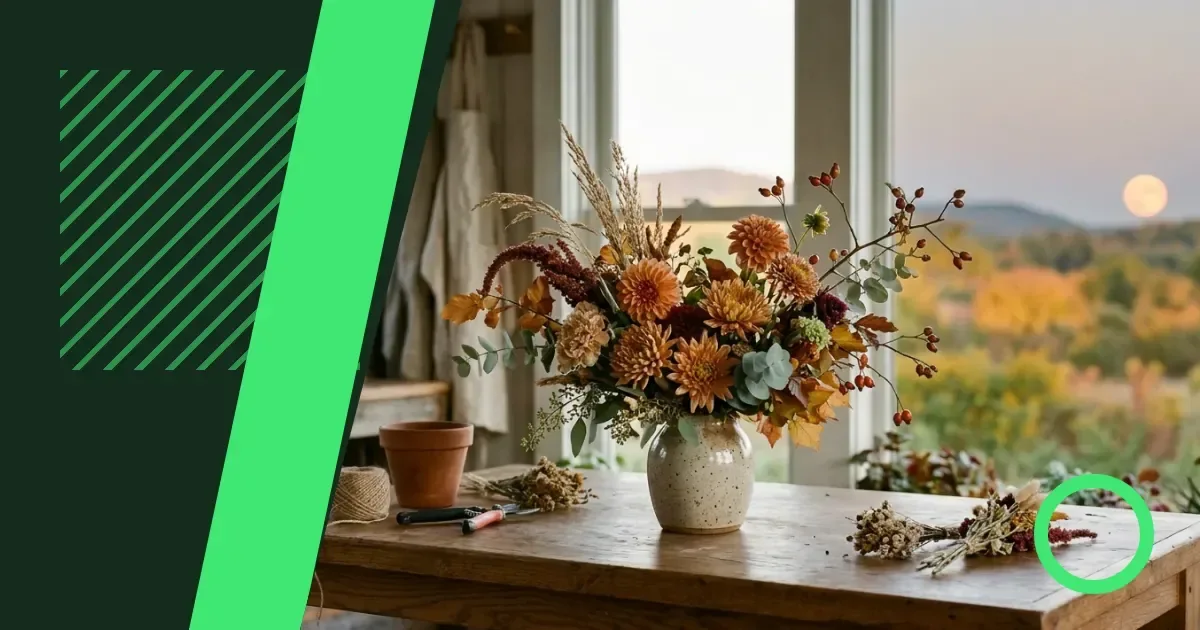
Seasonality shapes what blooms look their best and last longest in an arrangement. Spring brings tulips and ranunculus with sturdy stems and vivid colour; summer offers garden roses and delphiniums that hold their form in warmth; autumn delivers dahlias and chrysanthemums in rich, earthy tones. Choosing flowers at their natural peak means better value, less waste and designs that feel connected to the time of year.
Locally grown stems arrive fresher than imports and support growers in your region. British-grown sweet peas, for example, often reach a florist within hours of cutting, giving you several extra days of vase life compared to specimens flown in from overseas.
Why variety matters as much as bloom count
A successful arrangement balances form, texture and scale rather than relying on quantity alone. Pairing three types of foliage with two flower varieties creates more visual interest than a dozen stems of a single species. Contrast is the working principle: soft petals against structured seedheads, rounded blooms beside spiky forms, matte leaves next to glossy berries.
Sustainable principles that guide every choice
Floral foam, widely used in commercial floristry, is a single-use plastic that does not biodegrade. Switching to chicken wire, pin frogs or moss-based mechanics takes a little longer to set up but eliminates a significant environmental cost. Reusable vessels—ceramic bowls, glass cylinders, vintage tins—give arrangements character while reducing reliance on disposable containers.
Composting spent blooms returns nutrients to the soil. Petals, leaves and non-woody stems break down quickly in a garden compost bin; tougher material such as rose canes or thick branches should be cut into short lengths first. Water from vases, once cleared of debris, goes straight onto borders or pots rather than down the drain.
Design principles you can apply today
Every arrangement needs a focal point: the bloom or cluster that draws the eye first. Place it slightly off-centre and at varying heights to avoid a static, symmetrical look. Supporting flowers and foliage then build outward, creating depth by layering shorter material at the front and taller stems toward the back.
Odd numbers feel more natural than even groupings. Three roses, five stems of veronica or seven sprigs of eucalyptus settle into a composition more easily than pairs or quartets. This rule holds for small posies and large installations alike.
Colour confidence without guesswork
Monochromatic schemes—shades of one colour—deliver impact with minimal risk. A bowl of white ranunculus, cream lisianthus and pale green hellebores reads as elegant and cohesive without requiring advanced colour theory. Analogous palettes, using colours that sit beside each other on the wheel, offer slightly more variety: think peach roses, coral dahlias and soft pink astilbe.
Complementary pairings—opposites on the colour wheel—create drama. Purple and yellow, blue and orange, red and green all generate strong contrast. Start with one dominant hue and use the complement as an accent rather than a fifty-fifty split.
Skills that grow with practice
Wiring extends the life of fragile blooms and allows you to position them in ways their natural stems won't support. Threading a fine-gauge wire through the base of a tulip head, for instance, prevents the characteristic droop that appears after a day or two in water. Wrapping the wire down the length of the stem with floral tape conceals the support and gives you a flexible, durable structure to work with.
Taping individual stems before binding them into a bouquet creates a smooth, even handle and prevents bruising where stems cross. It's a small step that makes the difference between an arrangement that holds together through an afternoon and one that starts to loosen or slip.
- Strip leaves from the lower third of each stem to keep vase water clean and reduce bacterial growth.
- Cut stems at a sharp angle with clean secateurs to maximise the surface area for water uptake.
- Place stems in lukewarm water immediately; cold water slows hydration, especially for thick or woody stems.
- Change the water every two days and re-cut stems by half a centimetre each time to remove blocked capillaries.
Tools and materials that make the work easier
Sharp secateurs are non-negotiable. Blunt blades crush stems, closing the channels that draw water upward, and a crushed stem wilts faster no matter how often you refresh the vase. Bypass secateurs—the type with two curved blades that slide past each other—give the cleanest cut for most flower and foliage stems. Anvil secateurs, which press a single blade onto a flat surface, work better for dry, woody branches but damage soft, green growth.
A floral knife offers more control than secateurs when trimming delicate stems or shaping foam. The angled blade lets you work at tight angles without snapping fragile material. Pin frogs—metal grids with upright pins—anchor stems in shallow dishes without foam or tape. They're reusable, heavy enough to stay put and ideal for low, spreading arrangements where mechanics would otherwise show.
Conditioning extends vase life by days
Woody stems—roses, lilac, viburnum—benefit from splitting or crushing the bottom centimetre to increase water absorption. Hollow stems such as delphiniums and amaryllis should be turned upside down and filled with water, then plugged with cotton wool before going into the vase. Stems that bleed milky sap, including euphorbias and poppies, need their cut ends seared with a flame for a few seconds to seal the latex and stop wilting.
Where to take your skills next
Hands-on workshops, whether in-person or online, give you immediate feedback on technique and let you see how other arrangers solve the same design challenge. Look for sessions led by working florists rather than hobbyists; professional experience shows in how they handle tricky stems, manage time and troubleshoot mechanics on the spot.
Books remain one of the most reliable resources for in-depth technique. Constance Spry's work, though written decades ago, still offers foundational advice on form and proportion that hasn't dated. Contemporary titles from Ariella Chezar and Sarah Raven bring a modern, garden-led approach with an emphasis on seasonal, locally grown material.
Joining a local floristry group or arranging club connects you with others at a similar stage and gives you a reason to practise regularly. Shared costs on bulk flower orders, access to specialist suppliers and the chance to work on larger projects—installation pieces, community displays—all become possible when you're part of a group rather than working alone.
Frequently asked questions
How do I choose flowers that will last longest in a vase?
Select blooms that are just starting to open rather than fully blown, and check that stems are firm and leaves are crisp. Seasonal, locally grown flowers generally outlast imports because they've spent less time in transit.
What makes an arrangement look professional rather than amateurish?
Clean stems, varied textures and an off-centre focal point create a more refined look. Avoid spacing flowers evenly or arranging them all at the same height, as symmetry and uniformity tend to flatten the design.
Can I create arrangements without using floral foam?
Yes. Chicken wire, pin frogs and moss-based mechanics all hold stems securely and can be reused indefinitely. They take slightly longer to set up but eliminate the environmental impact of single-use foam.