Natural Movement and Control: Five Ways to Manage Tulips That Bend in the Vase
 Save
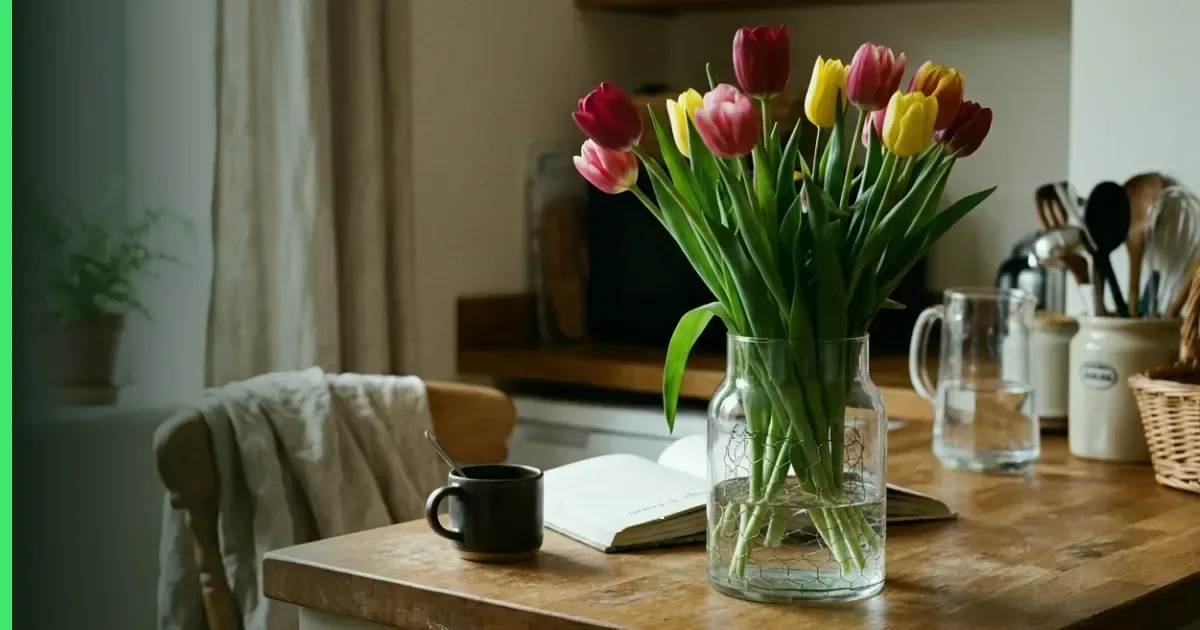
Tulips bend because they continue growing after they're cut, responding to light in a behaviour called phototropism. The stems curve towards the brightest source in the room, which is why a straight arrangement in the morning can look dramatically different by evening. You can't stop this movement entirely, but you can manage it through stem preparation, water depth, vase choice and positioning. Harvest Moon Floral Art walks you through the methods that keep tulip stems graceful rather than flopped over the rim.
Why tulips curve after cutting
Tulips are one of the few cut flowers that keep growing in the vase, adding length to their stems even after they're severed from the bulb. This growth is powered by water uptake and cell expansion in the stem tissue. At the same time, the flower heads turn towards the strongest light source in the room, a response driven by differential growth on either side of the stem. The shaded side grows faster than the lit side, creating the curve you see.
The movement is strongest in the first few days after cutting, when the stems are still turgid and the cells are actively expanding. Warmer rooms and bright, directional light accelerate the process. Older stems with less turgor pressure move less dramatically, though by that point the petals are usually past their best.
Fresh cuts and water uptake
Start by trimming half a centimetre from the base of each stem with sharp scissors or secateurs. A clean cut opens the vascular tissue and allows water to move up the stem without obstruction. Crushed or ragged cuts create barriers that slow hydration, and a dehydrated tulip stem bends more sharply because the cells lack the internal pressure to hold their shape.
Make the cut at a slight angle to increase the surface area for water absorption. Straight cuts can sit flat against the bottom of the vase, which limits contact with water. Re-cut the stems every few days to remove any bacterial build-up that blocks the vascular tissue.
Water depth and stem support
Tulips need less water than many people expect. Fill the vase so that the bottom few centimetres of each stem are submerged, but no more. Deep water encourages the stems to continue growing, which amplifies the bending behaviour. Shallow water provides enough hydration without fuelling excessive growth.
Change the water every other day to keep it clean. Bacteria multiply quickly in standing water, and they clog the cut ends of the stems. Cold water slows both bacterial growth and the tulips' metabolism, which moderates the speed of movement and extends vase life.
Vase shape and stem containment
A narrow-necked vase holds the stems upright and limits how far they can bend before they lean against each other or the vase wall. Tulips arranged loosely in a wide vase have more freedom to move, and the outer stems often flop over the rim once the curve becomes pronounced. If you prefer a relaxed, natural look, a wide vessel works well; for a more controlled arrangement, choose a vase with a neck that gathers the stems together.
Tall vases provide more stem support than low bowls. The additional height means a greater length of stem is enclosed, which distributes the bending force along a longer section rather than concentrating it near the top. That said, short vases suit tulips with naturally arching stems, where the curve is part of the design rather than a problem to solve.
Positioning the vase away from directional light
Place the arrangement where light comes from above rather than from one side. A central ceiling light or diffused daylight from multiple windows reduces the directional pull that causes dramatic curves. Avoid windowsills and spots near single lamps, where the contrast between lit and shaded sides of the stem is strongest.
Rotating the vase daily evens out the light exposure and prevents all the stems from bending in the same direction. One half-turn each morning distributes the phototropic response across the arrangement, so no single stem takes on an extreme curve.
Wrapping and conditioning for straight stems
Florists sometimes wrap tulip bunches in paper and stand them in water for a few hours before arranging them. The wrap holds the stems straight while they hydrate, which reduces the initial curve. You can replicate this by loosely rolling the tulips in newspaper, securing the bundle with an elastic band and standing them in a bucket of cold water.
Leave the wrapped stems for two to four hours, then remove the paper and arrange as usual. This technique works best when the tulips are freshly cut and haven't yet started bending. Once a pronounced curve has formed, wrapping won't reverse it entirely, though it may reduce the angle.
Working with the natural curve
Some arrangers prefer to let tulips move rather than fighting their behaviour. The curves add movement and softness to the arrangement, and they suit informal settings where stiffness would feel out of place. If you choose this approach, position the vase where the stems can bend without tipping over, and use other flowers or foliage to fill the gaps that appear as the tulips shift.
Parrot and fringed tulips, with their heavier, irregularly shaped heads, bend more dramatically than single or double varieties. French tulips, bred for their long stems, curve gracefully when given space. Matching the variety to the style of arrangement helps you work with the movement rather than against it.
Step-by-step preparation for controlled arrangements
- Trim each stem at an angle with clean, sharp blades, removing any lower leaves that would sit below the waterline.
- Fill the vase with cold water to a depth that covers the bottom few centimetres of stem only.
- Arrange the tulips in a narrow-necked vase, grouping the stems so they support each other.
- Place the vase in a spot with even, diffused light rather than strong directional sun or a single lamp.
- Change the water and re-cut the stems every other day to maintain hydration and reduce bacterial build-up.
Stem treatment comparison
| Method | Effect on movement | Ease of use |
|---|---|---|
| Shallow water | Slows growth and bending | Simple; requires daily monitoring |
| Wrapping in paper | Straightens stems during conditioning | Takes a few hours; works best on fresh stems |
| Narrow vase | Limits range of movement | Immediate; depends on vase shape |
| Diffused light placement | Reduces directional bending | Simple; limited by room layout |
Choosing tulips for different arrangements
Single-flowered tulips with firm, closed heads stay upright longer than fully open blooms with heavy petals. Buying tulips in bud gives you a few extra days before the stems start bending noticeably. Check that the stems are firm and the leaves are crisp, not limp or yellowing, which indicates poor hydration before purchase.
If you're making a hand-tied bouquet or a centrepiece where straight stems matter, select varieties known for sturdy stems rather than those bred for dramatic curves. Triumph tulips and Darwin hybrids hold their shape well. Buying flowers at market gives you the chance to choose stems by hand and ask the grower which varieties behave predictably in the vase.
When bending becomes wilting
A tulip that's curving towards the light is still healthy, with petals that feel firm and stems that resist gentle pressure. A wilting tulip has soft, collapsing stems and petals that droop downwards rather than turning sideways. Wilting is caused by air locks in the vascular tissue or severe dehydration, and it's distinct from the phototropic bending that's normal for the species.
If the stems feel hollow or papery when you press them lightly, they've lost too much water to recover fully. Re-cutting the base and standing them in deep, cold water for an hour may revive them partially, though the vase life will be shorter. Emergency revival techniques cover the steps that work when flowers lose turgor pressure suddenly.
Foliage and companion stems
Adding structural foliage or other upright stems to the arrangement helps disguise the tulips' movement and fills the spaces that appear as they curve. Eucalyptus, ruscus or pittosporum provide a framework that supports the tulips visually without restricting them physically. Mixing tulips with daffodils is best avoided; daffodil stems release sap that shortens the vase life of other flowers.
If you're arranging tulips with roses or ranunculus, place the tulips towards the centre where their movement is less obvious. The sturdier stems around the edge hold the arrangement's shape, while the tulips add height and colour without needing to stay perfectly vertical.
#Stem care #Vase life #Conditioning
Download PDF: Daily Tulip Care Checklist PDF, 27 KB
Frequently asked questions
Why do tulips droop in the vase even when they have water?
Tulips bend towards light rather than drooping from lack of water. They continue growing after cutting and respond to the brightest source in the room, which creates curves in the stems. A truly wilting tulip feels soft and collapses downwards, while a bending tulip has firm stems that turn sideways.
Can you keep tulip stems straight in an arrangement?
You can reduce the amount of movement by using shallow water, a narrow vase and diffused light, but you can't stop tulips from bending entirely. Wrapping freshly cut stems in paper for a few hours helps them straighten during conditioning, though they'll still respond to light once arranged.
How do you stop tulips from flopping over the side of the vase?
Choose a vase with a narrow neck that holds the stems upright and place it away from strong directional light. Shallow water slows the growth that makes stems curve sharply, and rotating the vase daily spreads the bending across all the stems rather than letting some flop while others stay straight.